Cheap SEO Services: Why Cheap SEO Isn't What You Need
Cheap SEO can feel like an easy decision, especially when budgets are tight. It promises visibility without a large upfront investment, which makes it appealing for many businesses trying to grow.
But SEO isn’t really a quick fix. The approach behind the work tends to matter more than the price itself. How strategies are built, how much research goes into them, and how the work is executed all shape the outcome.
Over time, lower-cost SEO often leans toward speed and scale instead of intention. And that shift can impact not just rankings, but how your site performs and how sustainable your growth actually is.
It’s not about needing the biggest budget. It’s about understanding the trade-offs and making decisions that support long-term progress rather than short-term wins.
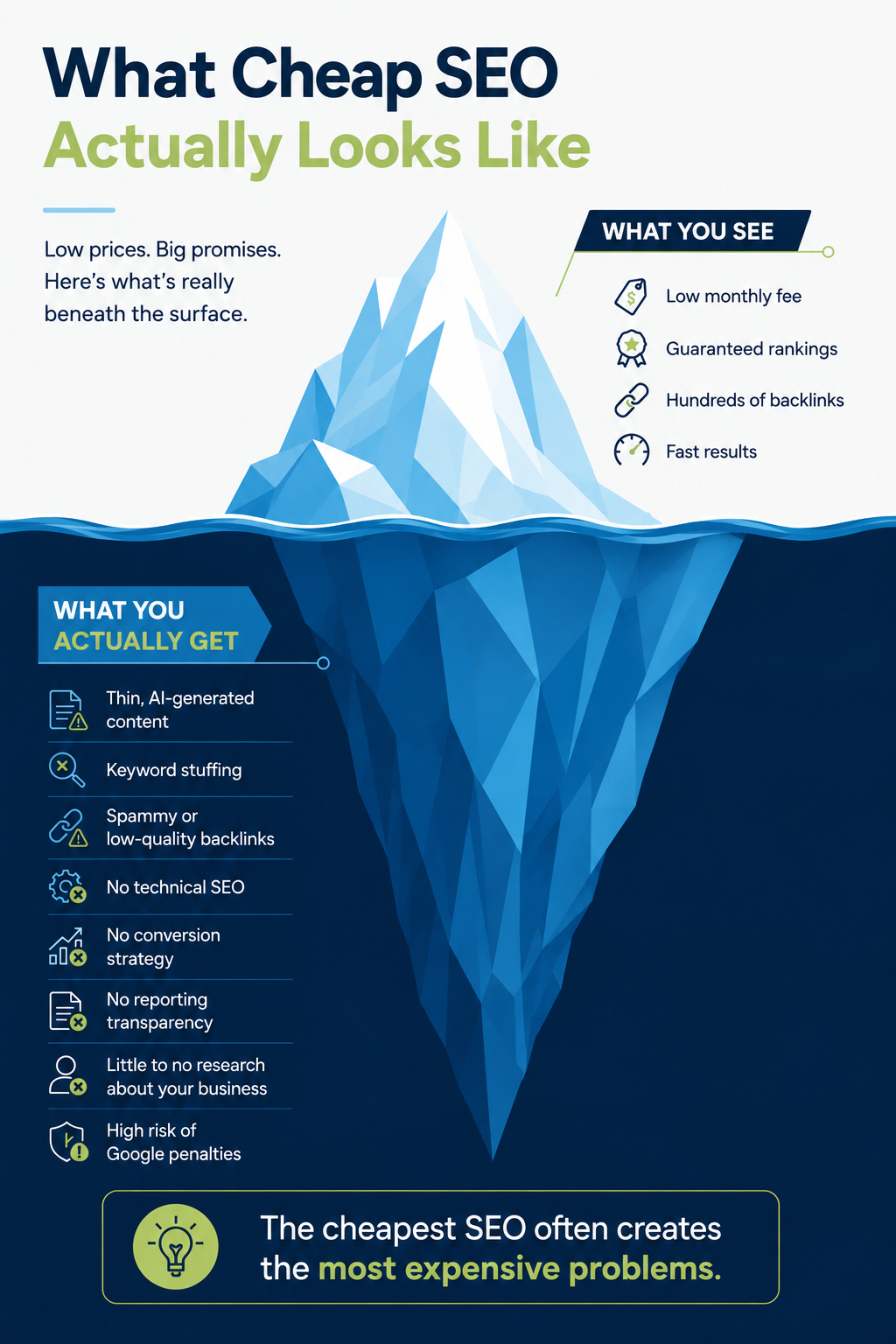
What Cheap SEO Actually Looks Like
Cheap SEO can mean different things depending on the business, but the way these services are structured tends to follow similar patterns.
Most low-cost SEO packages are built to scale. That usually means standardized deliverables, limited research, and processes designed to support a high volume of clients. You might still see keyword targeting, content updates, or link building, but the work is typically applied broadly rather than shaped around your specific goals.
That’s where the difference between cheap and affordable becomes more noticeable. Affordable SEO is about making smart decisions within a limited budget. Cheap SEO usually lowers the level of strategy and customization to reduce cost.
At first glance, the work can look similar. Over time, the gap becomes clearer in how well the strategy connects with your audience, how your site performs, and how much impact it has on your business.
Why Cheap SEO Often Falls Short
On the surface, cheap SEO can look like it’s checking the right boxes. There may be regular updates, reports, and visible activity. But the gap usually shows up in how those efforts connect back to real outcomes.
SEO works best when it’s built around a clear understanding of your audience and how they search. That includes search intent, competition, and how your site is structured. When that layer is rushed or skipped, the work that follows can feel disconnected. You might see traffic increase, but not in a way that leads to meaningful engagement or conversions.
Another common pattern is prioritizing volume over precision. More keywords, more backlinks, more content. On their own, these can be useful. But without a clear strategy behind them, they don’t always move things forward in a meaningful way.
Over time, this creates a situation where effort is being made, but progress feels inconsistent. That’s usually the signal. It’s not that SEO isn’t working. It’s that the approach behind it isn’t fully aligned with what drives results.
Common Patterns Behind Low-Cost SEO Services
Once you look a little closer, most cheap SEO services start to follow the same patterns. The specifics might vary, but the underlying approach is usually similar.
1. Speed Over Sustainability
There’s usually an emphasis on quick movement. Faster deliverables, faster rankings, faster results.
The challenge is that SEO rarely works that way. Real progress comes from developing relevance and earning trust over time. When the focus shifts too heavily toward speed, the work behind it can lose depth, and the results don’t always hold.
This is where it can start to feel a bit like placing a quick bet. You might see a short-term lift, but there isn’t much supporting it long-term.
2. Limited Research and Context
Strong SEO starts with understanding. That includes your audience, what they’re searching for, and how competitors are showing up.
Low-cost services don’t always have the space to go deep here. Research may be surface-level, which makes it harder to align content and targeting with real user intent.
When that alignment is off, traffic can come in without translating into meaningful engagement.
3. Scaled Work Instead of Tailored Strategy
To keep costs down, many services rely on repeatable systems. The same frameworks are applied across different clients, regardless of industry or goals.
That approach can create consistency, but it also limits flexibility.
SEO strategies usually perform better when they’re shaped around the specifics of a business, not applied as a template.
4. Activity Without Clear Impact
You’ll still see deliverables. Reports, keyword tracking, and content updates.
But not all activity leads to progress. If the work isn’t tied back to clear goals, it becomes harder to understand what’s actually improving.
That’s where things can start to feel unclear. There’s movement, but not always direction.
5. Short-Term Outputs Over Long-Term Assets
Effective SEO creates value over time. Things like strong content, a well-structured site, and credible backlinks continue to support performance long after they’re created.
Lower-cost approaches don’t always invest in those areas. Instead, the focus can shift toward outputs that are easier to produce but don’t carry the same long-term impact.
And that difference becomes more noticeable as time goes on.
The Hidden Cost of Cheap SEO
The cost of cheap SEO isn’t always obvious at the start. On the surface, things can look like they’re moving. Rankings shift, traffic increases, and reports show steady activity.
The difference shows up in what that traffic actually leads to.
For example, a site might begin ranking for a wider set of keywords and see more visitors as a result. But if those keywords don’t align with what potential customers are actually searching for, that traffic doesn’t turn into leads. It looks like progress, but it doesn’t move the business forward in a meaningful way.
There’s also the opportunity cost. Time and budget go toward work that doesn’t create lasting impact, while areas like content quality, site experience, and search intent alignment receive less attention.
In some cases, there’s cleanup involved. Fixing low-quality backlinks or reworking content can take more time than starting with a stronger approach.
It’s not always about losing progress. Sometimes it’s about how long it takes to get where you were trying to go in the first place.
What Good SEO Usually Looks Like
Good SEO is less about doing more, and more about doing the right things with intention.
It starts with understanding how people search and what they’re actually trying to find. That context helps guide decisions around keyword targeting, content creation, and how your site is organized.
From there, execution becomes the focus. Creating useful content, improving site performance, and making it easier for users to navigate. These aren’t one-time fixes. They’re ongoing improvements that add up over time.
There’s also a clear connection between the work being done and the outcomes it drives. Efforts are tied to specific goals, like generating leads, improving engagement, or increasing visibility for relevant searches.
In practice, good SEO is iterative. You make updates, review performance, and adjust based on what you’re seeing. As those adjustments add up, that’s where consistent growth begins to take shape.
If Budget Is a Concern, Here’s Where to Start
Not every business is in a position to invest heavily in SEO right away. That’s a common starting point. The goal isn’t to do everything at once, but to focus on the areas that can make a meaningful difference early on.
1. Focus on the Basics First
Start with the foundation. Make sure your site is easy to navigate, loads quickly, and clearly communicates what you offer. Even small improvements here can have a noticeable impact. If users can’t find what they need or the site feels slow, it becomes harder for any SEO effort to perform well.
2. Invest in Content Gradually
You don’t need a large content library right away. A smaller number of well-thought-out pages can go further than a high volume of surface-level content. Focus on answering real questions your audience has. Consistency usually matters more than scale.
3. Get Strategic Guidance When You Can
If a full-service agency isn’t realistic yet, consider working with a consultant or getting a one-time audit. This can help you focus your efforts in the right areas and avoid spending time on things that won’t move the needle. A little direction early on can save a lot of trial and error later.
4. Build Internal Understanding
SEO works best when it’s part of how your team thinks about marketing, not just a separate initiative. Taking time to
understand the basics can help you make better decisions, prioritize the right work, and evaluate results more clearly as you go.
How to Evaluate an SEO Partner
If you’re considering outside help, it’s worth taking a step back and looking at how an SEO provider approaches the work, not just what they promise.
A good starting point is how they explain their strategy. You should have a clear understanding of what they’re doing, why it matters, and how it connects to your business goals. If the explanation feels vague or overly simplified, that’s usually a signal to ask more questions.

It’s also helpful to look at how they measure success. Rankings and traffic can be part of the picture, but they shouldn’t be the only focus. Strong SEO partners tie their work back to outcomes like lead quality, engagement, and overall site performance.
Communication plays a role here, too. You don’t need constant updates, but you should feel informed and able to have a conversation about what’s working and what isn’t. SEO is an ongoing process, and clarity makes it easier to adjust as things evolve.
The right partner helps you make better decisions about where to focus and how to improve, not just execute tasks.
A More Sustainable Approach to SEO
SEO is an ongoing process of testing, learning, and improving. When that process is handled with intention, the results tend to be more stable and more meaningful.
If you’re thinking through your next steps or want a clearer picture of how your current strategy is performing, it can help to have an outside perspective. At
RivalMind, we work with businesses to understand what’s driving performance, where gaps exist, and how to prioritize the work that will have the most impact.
In many cases, that starts with simplifying the approach. Focusing on what matters, making steady improvements, and adjusting based on real data. If that’s something you’re exploring, we’d be happy to
talk through it with you and help identify the right next steps.

Meet the Author
Dan Hayward
Search Marketing Strategist
Dan Hayward is a Search Marketing Strategist at RivalMind who brings curiosity and intention to every campaign. With a special interest in PPC and user experience, he digs into the data to uncover what works and why. Whether he’s optimizing ad spend or exploring conversion paths, Dan’s always thinking a few steps ahead to help clients grow with clarity and purpose.
Specialties: User Experience Insight, PPC results, RivalMind Bar Back
Looking for more organic website traffic?
Welcome to RivalMind. Our purpose is to help your business thrive. We are a digital marketing agency that offers SEO, PPC, Web Design, Social Media and Video Solutions as tools to our clients for online business development and growth.
Contact us today to get started!
Blog Contact Form
We will get back to you as soon as possible.
Please try again later.